install.php Has Been a Security Problem Since 2007
Drupal patched a critical installer flaw on 18 November. It is the fifth time the same file has produced an advisory in nineteen years. Why it keeps coming back, where the chain to code execution actually breaks, and why the 9 December deadline makes this one different.
On 18 November, Drupal shipped a fix for a critical flaw in its installer. SA-CORE-2026-017, CVE-2026-132165, rated 18 out of 25. Under certain conditions an attacker can use the installer to try to reinstall the site, and that gets you site takeover or remote code execution.
I went looking for the last time this happened, mostly out of curiosity. Then I kept going, because it turns out there are four of them.
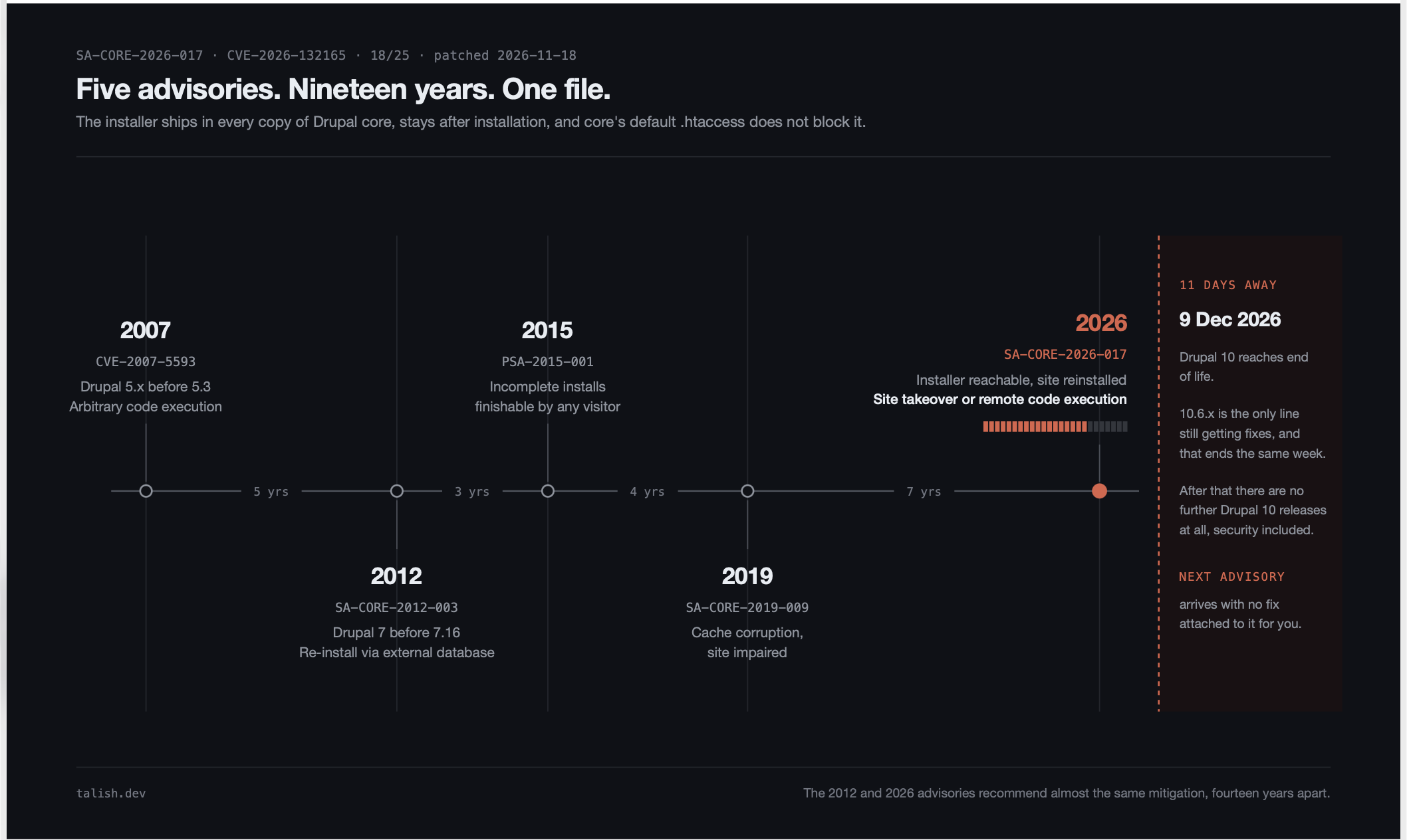
The same file, five times
2007. Drupal 5.x before 5.3. When the configured database server was unreachable, a remote attacker could execute arbitrary code through vectors that caused settings.php to be modified.
2012. SA-CORE-2012-003, Drupal 7 before 7.16. A bug in the installer let an attacker re-install Drupal against an external database server under certain transient conditions, which allowed arbitrary PHP execution. The advisory noted it only worked if settings.php or the sites directories were writable by or owned by the webserver user.
2015. PSA-2015-001. Not a code bug this time, a configuration one. If an installation was never completed past the database configuration step and install.php was still reachable, any visitor could finish the installation pointed at a database of their choosing, and then use that database to execute code on the server.
2019. SA-CORE-2019-009. Milder. A visit to install.php could corrupt cached data and leave the site impaired until caches were rebuilt. The suggested mitigation, again, was to block access to install.php if you did not need it.
2026. The one from ten days ago.
Read the 2012 advisory and the 2026 advisory next to each other and the mitigation sentence is almost the same. Fourteen years apart, and the answer is still that some exploit paths close if the web server cannot write to settings.php.
That is not a criticism of the security team. If anything it is the opposite. Five separate times they found it, scored it, coordinated it and shipped it, and the 2026 one came with a public warning on the Monday before the Wednesday release so people could clear time. The process is working.
The question that interests me is why the same file keeps showing up.
Why it keeps coming back
The installer ships in every copy of Drupal core, as /core/install.php, and it stays there after you have installed. Core's default .htaccess does not block requests to it. So the standing mitigation, the one repeated across nineteen years of advisories, is that every site operator should go and block it themselves in their webserver config.
Think about what that means in practice. There is a file with enormous latent authority sitting in the docroot of effectively every Drupal site on the internet, and the thing that keeps it safe is a config change that nobody is forced to make, that does not appear in any deployment checklist by default, and that produces no error or warning if you skip it.
Most sites skip it. Not out of negligence. Nothing in the normal course of building and launching a site ever brings it up.
This is the shape of a lot of long-lived security problems. Not an unfixed bug. A safe default that was never made the default, with the work delegated to thousands of individual operators who each have to independently know to do it.
Where the chain to a shell actually breaks
The installer flaw by itself does not hand anyone a shell. It is worth being precise about this, because the gap between "critical advisory" and "someone is running commands on your box" is where all the useful engineering lives.
The installer's entire job is to point a Drupal site at a database and write that connection into settings.php. That is a lot of authority for a file to keep after its job is finished. If someone can reach the installer and get the site pointed at infrastructure they control, they are no longer poking at your application from outside. They are supplying it with its own state, and a Drupal database is not inert rows. The application acts on what is in there.
Once that lands you have code execution as whatever user PHP runs as. What happens next is entirely down to decisions you made months earlier. On a sanely configured box that is a constrained account that cannot write to application code, and the attacker's options narrow quickly. On a box where the webserver owns the docroot, it can leave something behind, and at that point the original vulnerability stops mattering because it is no longer needed to get back in.
Which is why both the 2012 and the 2026 advisories point at the same thing: permissions on settings.php and the sites directory. That control is not in the patch. It was never in the patch. It is yours, and it is the difference between a bad advisory and a bad month.
Patching and hardening are two different jobs. Doing one well does not cover the other.
The part that makes this one urgent
Drupal 10 reaches end of life on 9 December 2026. That is eleven days from when I am writing this.
Drupal 10.6.x is the only Drupal 10 line still receiving security fixes, and that coverage ends the same week. Anything on 10.5.x lost support back in June. After the 9th there are no further Drupal 10 releases at all, security ones included.
So line it up. A critical installer flaw lands on 18 November. If you are on 10.6 you can take the patch. If you were already on 10.5 you could not. And in eleven days the entire Drupal 10 branch joins 10.5.
The site does not stop working on 10 December. It serves pages exactly as it did the day before. What changes is that the next advisory, whenever it comes, arrives with no fix attached to it for you.
Three things have to be true for a disclosure to pass you by without damage. Someone has to ship a fix. You have to be running something that can receive it. And you have to apply it before the window closes, which for anything with a public proof of concept now means hours rather than weeks.
Drupal handled the first one, well, on schedule, with advance warning and a severity score. The other two are yours. And for a lot of sites, the second one has a hard expiry date on it in under two weeks.
This is not really a Drupal story
Installers that ship with the product and stay after setup are a permanent attack surface, and they are everywhere. WordPress keeps its own. So does a good chunk of the PHP ecosystem. Admin panels, setup wizards, debug endpoints, seeded default credentials, the diagnostic script somebody added during launch week and never removed.
All of them share the same profile. High authority, needed once, never cleaned up, and invisible in every normal day of operating the site. Nothing in your monitoring tells you that a privileged setup script is still reachable, because from the server's point of view nothing is wrong.
If you want one exercise out of this post, it is not about Drupal. Go and find every endpoint in your stack that exists to do setup, debugging or administration, and check whether it is still reachable from the internet. Most teams find at least one thing they had entirely forgotten was there.
What to actually do this week
If you run Drupal, update to 10.6.22, 11.3.22 or 11.4.13 depending on your branch, and then block /core/install.php at the webserver or in .htaccess anyway. The patch and the block are not substitutes for each other, and the block costs you two lines.
While you are in there, check that the webserver user does not own and cannot write to settings.php or the sites directory. The Security Review module will tell you about weak file permissions and ownership if you would rather not audit it by hand.
And if you are still on Drupal 10 with no migration plan, the honest position is that the deadline already passed. Not the 9 December one, the one where you had enough runway to do it calmly. A Drupal 10 to 11 upgrade is not a weekend, and December is the worst possible month to start one, with Drupal 12 and 11.5 landing the same week. It still needs starting.
Nineteen years is a long time for one file to keep turning up in advisories. It will probably turn up again. The useful question is not whether the next one exists, it is whether you will be running something that can still receive the fix.
Sources
- SA-CORE-2026-017 / CVE-2026-132165, Drupal core installer, critical 18/25, 18 November 2026
- SA-CORE-2012-003, Drupal core 7.x arbitrary PHP code execution via installer
- PSA-2015-001, Drupal core remote installation
- SA-CORE-2019-009, install.php cache corruption
- CVE-2007-5593, Drupal 5.x install.php arbitrary code execution
- Drupal core release schedule, drupal.org (Drupal 10 end of life 9 December 2026, 10.6.x final minor)
- Drupal security risk levels, based on NIST Common Misuse Scoring System (NISTIR 7864)
Read next
- Jul 24, 2026
Layout Builder Is Over-Applied: A Decision Framework for When It Actually Fits
Layout Builder has become the reflexive answer in Drupal to "how should editors build pages." Somewhere along the way it stopped being one option among several and became the default. That is a mistake I see repeated across projects. Layout Builder is a genuinely good tool for a specific job. The problem is that it gets chosen for jobs it is not suited to, usually because it is the most visible option and nobody paused to ask whether it fit. This post is the decision framework I use to choose between Layout Builder, Paragraphs, custom templates, and plain blocks.
- Jun 23, 2026
I Keep Evaluating Alternatives to Drupal. I Keep Choosing Drupal. Here Is the Actual Reasoning.
I don't ignore the alternatives to Drupal. Sanity, Payload, Strapi, custom Next.js builds. I've built real things with several of them. When a project's requirements push me to look elsewhere, I take them seriously. Here is the honest reasoning behind why I keep choosing Drupal anyway.
- May 25, 2026
Stop Making Users Pay for Work Your CI Pipeline Could Do
Most slow Drupal sites are not slow because the code is wrong. They are slow because expensive work runs at request time when it could have run in the CI pipeline instead. Cold caches, image derivatives, search indexes. The pattern repeats. The fix is the same in every case: move the cost off your users and onto a controlled environment where nobody is waiting. This is a principle, not a tip. Three examples below to make it concrete.