I Keep Evaluating Alternatives to Drupal. I Keep Choosing Drupal. Here Is the Actual Reasoning.
I don't ignore the alternatives to Drupal. Sanity, Payload, Strapi, custom Next.js builds. I've built real things with several of them. When a project's requirements push me to look elsewhere, I take them seriously. Here is the honest reasoning behind why I keep choosing Drupal anyway.
I Keep Evaluating Alternatives to Drupal. I Keep Choosing Drupal. Here Is the Actual Reasoning.
Why I Bother Looking at All
There is a failure mode among experienced developers where they defend their stack because switching would invalidate years of accumulated expertise. The sunk cost is real and the bias is real. The antidote is to take the alternatives seriously when the opportunity comes, build something real with them, and see whether they have caught up.
So when a project's requirements actually push me toward another tool, or when I am curious enough about a new one to spend real time on it, I do exactly that. I read the docs properly. I build a non-trivial prototype. I model a real content structure, not a blog with three fields. I look at what production would actually require. Then I compare honestly.
This post is the result of those evaluations. It is not a Drupal sales pitch. It is the reasoning of someone who has genuinely used the alternatives and keeps finding that, for the work I do, the decision still holds.
Where the Alternatives Are Genuinely Better
Let me start here, because a post that only praises Drupal is not credible.
The modern headless stacks are genuinely better at greenfield speed. If I am starting a small-to-medium project with a clean content model and a React frontend, Sanity or Payload will get me to a working state faster than Drupal will. The developer experience is smoother. The frontend integration is more natural. The mental overhead is lower. For a certain class of project, they are simply the better choice, and I have recommended them when that was the case.
Custom Next.js builds give you total control. No framework opinions to fight. No contrib modules to maintain. For a team with strong frontend engineers and a genuinely unusual set of requirements, building from scratch can be the right call.
These are real advantages. I am not going to pretend otherwise. If your project is greenfield, your content model is simple, and your team is React-native, the alternatives deserve serious consideration and might win.
Where They Keep Falling Short
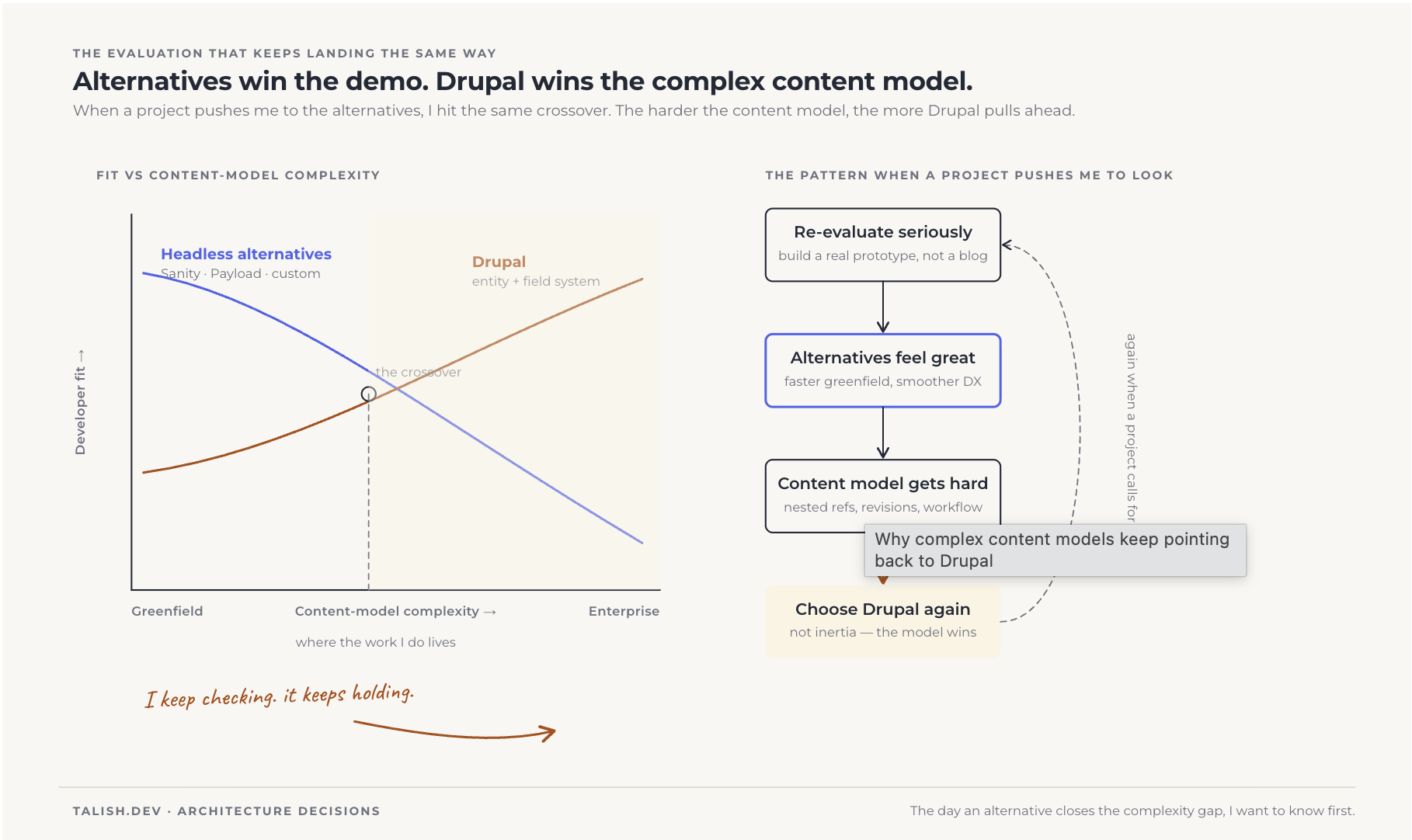
Here is the pattern I keep hitting. The alternatives are excellent at greenfield and start to strain the moment the content model gets genuinely complex.
A blog with posts and authors is easy in any of these tools. A content structure with deeply nested relationships, polymorphic references, conditional fields, revision workflows across content types, and the kind of editorial complexity that real enterprise content demands is where the headless tools start showing their age, and where Drupal's entity and field system pulls ahead.
This is the single most consistent finding across every round of re-evaluation I have done. The tools that win the demo lose the complex content model. Drupal that loses the demo wins the complex content model. And in the kind of work I do, the content model is almost always complex.
The Four Reasons I Keep Choosing Drupal
When I strip away the noise, four things keep Drupal as my default for the work I actually do.
1. The content modeling is genuinely better
Drupal's entity and field system is the best content modeling foundation I have worked with, and I have worked with most of them. The ability to define content types with arbitrary fields, reference entities polymorphically, attach fields to anything, build view modes for different rendering contexts, and have all of it integrate cleanly with revisions, translations, and access control is not matched by the headless alternatives.
The headless tools model content as documents with schemas. That works beautifully until your content is not really document-shaped. Drupal models content as entities in a relational graph, which is harder to learn and more powerful when the structure gets complex. For the content I work with, that power is the difference between a clean implementation and a pile of workarounds.
2. Long-term maintenance and stability
I have Drupal sites I built years ago that still run, still update, still get security patches, and still make sense to a developer opening the codebase for the first time. The upgrade path from Drupal 8 forward has been genuinely good, and the project takes backward compatibility and security seriously in a way that matters when you are responsible for a site over years rather than months.
The headless ecosystem moves faster, which is exciting and also exhausting. Tools get acquired, change pricing, deprecate APIs, or simply lose momentum. Betting a long-lived enterprise site on a venture-funded SaaS CMS means betting on that company's roadmap and survival. Drupal is not going to get acquired and pivot. That stability has real value when the site needs to live for a decade.
3. Ecosystem and community depth
Twenty years of contrib modules, documentation, Stack Exchange answers, and accumulated community knowledge is a moat that is easy to undervalue until you need it. When I hit an unusual problem in Drupal, someone has almost certainly hit it before and written about it. The depth of the ecosystem means most problems are solved problems.
The newer tools have enthusiastic communities, but they do not have twenty years of accumulated edge-case solutions. When you hit the unusual problem in a younger ecosystem, you are often the first one there, which means you are solving it from scratch.
4. Migration and enterprise-scale capability
Drupal's Migrate API and its broader enterprise tooling (multilingual, workflow, content moderation, granular permissions, multisite) are built for the scale and complexity that enterprise content operations actually have. I have migrated large, messy, legacy content estates into Drupal, and the tooling for that work is mature in a way the alternatives have not matched.
When a project involves moving hundreds of thousands of pieces of content from a legacy system, with all the data-cleaning and field-mapping and URL-preservation that entails, Drupal has the tools and the patterns. Most of the alternatives assume you are starting fresh, because greenfield is where they shine.
What This Means in Practice
The honest synthesis is this. Drupal is not the right answer for every project, and I do not pretend it is. For greenfield projects with simple content models and React-native teams, the alternatives are often better and I will say so.
But for the work I actually do, which involves complex content models, enterprise requirements, long-lived sites, and frequently the migration of large legacy content estates, Drupal keeps winning the evaluation. Not because I am attached to it. Because every time I take the alternatives seriously and build something real with them, I hit the same wall: they are excellent until the content model gets hard, and then Drupal pulls ahead.
The decision is not "Drupal is best." The decision is "Drupal is best for this kind of work," and the kind of work I do keeps being that kind.
Closing Thought
The reason I stay aware of the alternatives is that the day one of them closes the gap on complex content modeling, long-term stability, and enterprise migration, I want to know about it before my competitors do. So far that day has not come. The headless tools keep getting better at the things they were already good at, and keep not solving the things Drupal is good at.
Maybe that changes. Maybe Payload or whatever comes next builds a content modeling system that matches Drupal's entity API while keeping the modern developer experience. If it does, I will notice, because I pay attention. Until then, the choice keeps making itself.
If you have moved from Drupal to one of the alternatives and it held up on a genuinely complex content model, I would be curious to hear about it. That is the case I keep expecting to find and keep not finding, and I would rather learn it from you than from losing a project.
Read next
- Jul 24, 2026
Layout Builder Is Over-Applied: A Decision Framework for When It Actually Fits
Layout Builder has become the reflexive answer in Drupal to "how should editors build pages." Somewhere along the way it stopped being one option among several and became the default. That is a mistake I see repeated across projects. Layout Builder is a genuinely good tool for a specific job. The problem is that it gets chosen for jobs it is not suited to, usually because it is the most visible option and nobody paused to ask whether it fit. This post is the decision framework I use to choose between Layout Builder, Paragraphs, custom templates, and plain blocks.
- May 25, 2026
Stop Making Users Pay for Work Your CI Pipeline Could Do
Most slow Drupal sites are not slow because the code is wrong. They are slow because expensive work runs at request time when it could have run in the CI pipeline instead. Cold caches, image derivatives, search indexes. The pattern repeats. The fix is the same in every case: move the cost off your users and onto a controlled environment where nobody is waiting. This is a principle, not a tip. Three examples below to make it concrete.
- May 15, 2026
Drupal Got Cache Invalidation Right. The Rest of the Industry Is Catching Up.
Drupal's cache tag system is one of the better-designed cache invalidation models in modern web frameworks. A practitioner's look at why it works, where it breaks across system boundaries, and the mental model that travels to any stack.